ByJohn A
Natural Language Processing for Clinical Notes: Extracting Structured Data From Free Text
Table of Contents
▸ 1. How Does Clinical NLP Actually Work?
▸ 2. What Can Clinical NLP Extract From Notes? Use Cases in 2026
▸ 3. How Accurate Is Clinical NLP, and Where Does It Fail?
▸ 4. How Do You Build a Clinical NLP System Step by Step?
▸ 5. What Training Data Does Clinical NLP Need?
▸ 6. How Much Does Clinical NLP Development Cost in 2026?
▸ 7. The Clinical NLP Readiness Checklist
▸ 8. Frequently Asked Questions
What if the most valuable clinical data in your organization is hidden in plain sight? Around 80% of healthcare data exists in unstructured clinical notes, making it difficult to analyze, search, or use for research and quality reporting. Organizations are increasingly turning to Acquaint Softtech to unlock this data with AI-powered healthcare solutions.
This article explains how clinical NLP transforms unstructured medical text into structured, actionable insights, reducing manual data abstraction while improving analytics, research, and patient care.
As an AI and Healthcare Integration Engineer at Acquaint Softtech, I build the pipelines that turn that free text into structured, queryable data. The technology is mature enough in 2026 to be trusted for extraction, provided it is scoped and validated correctly. Our AI and ML development services deliver clinical NLP pipelines for healthcare organisations across the USA, UK, and Europe.
This is an NLP guide in the AI and ML cluster. For how the structured output feeds analytics and research, the Healthcare Data Warehouse Architecture guide shows where NLP output lands in a clinical data platform.
How Does Clinical NLP Actually Work?
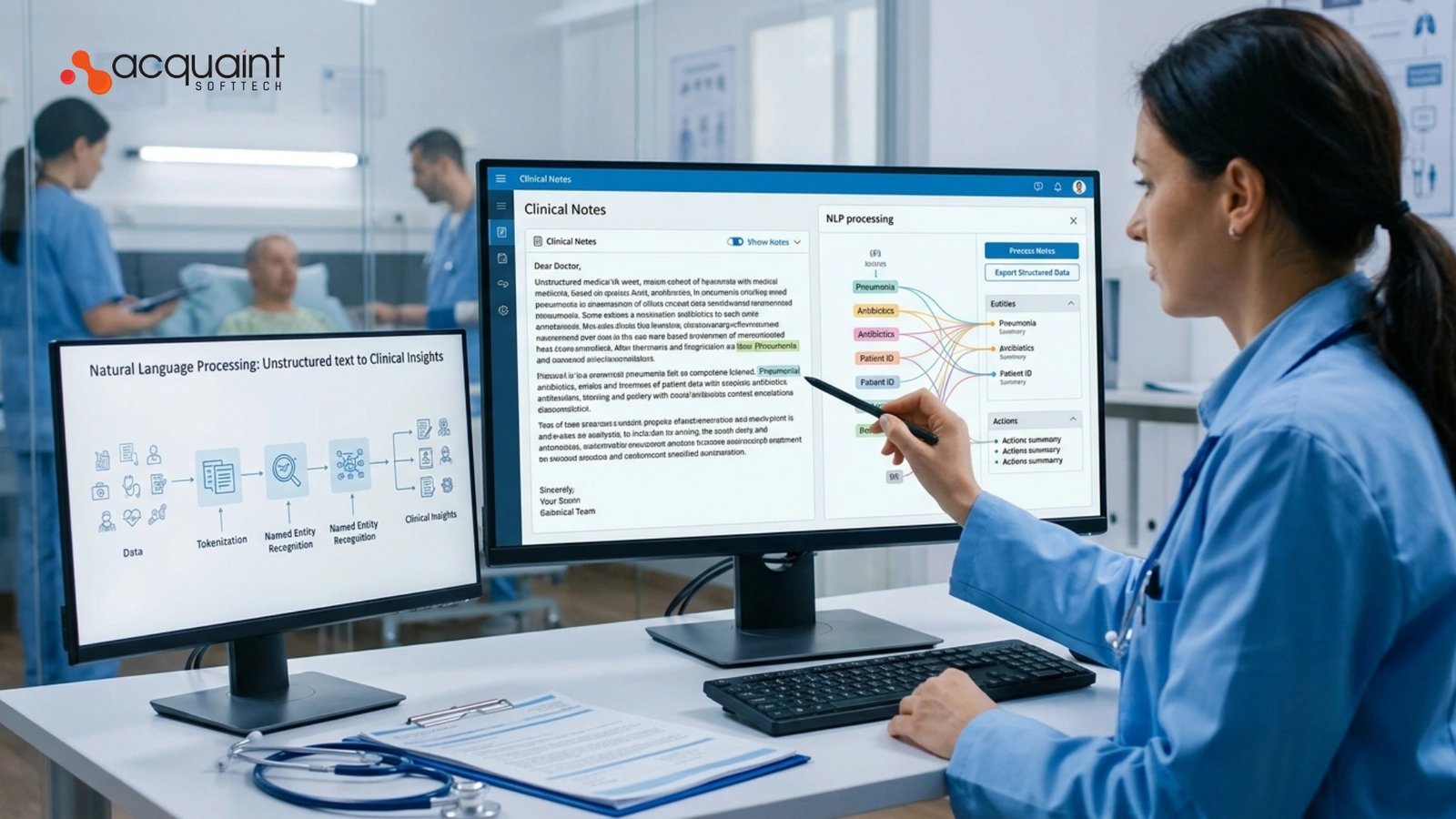
Clinical NLP works by passing free-text notes through a pipeline that identifies, classifies, and codes medical concepts. The core step is Named Entity Recognition (NER), which locates and labels entities such as diseases, medications, symptoms, and procedures. Encoder models like BERT are preferred over generative LLMs for NER because they are far less prone to hallucination.
The processing stages
A note first passes through preprocessing and segmentation, because clinical notes are long and standard models lose context across them. Truveta’s production approach uses a segmentation-based BERT model with a BiLSTM layer to persist global context across segments.
After NER, a relation-extraction step links entities, for example, connecting a drug to its dosage, and a normalisation step maps each concept to a standard code. The output is structured, queryable data instead of prose.
The architecture choice between encoder models and generative LLMs is the single most consequential decision in a clinical NLP build. Acquaint Softtech’s software product development practice scopes that choice against accuracy, scale, and cost before any model is trained.
The pipeline only delivers value if its output integrates cleanly with the systems that consume it. Our Python developers build clinical NLP pipelines on proven libraries and wire the structured output into downstream EHR and analytics systems.
What Can Clinical NLP Extract From Notes? Use Cases in 2026
Clinical NLP extracts four main categories of structured data: named entities (diseases, medications, symptoms, procedures), standardised codes (ICD, SNOMED CT, LOINC, CPT), patient phenotypes for cohort identification, and temporal information such as disease onset and treatment timelines. These power coding automation, research, quality measures, and precision medicine (John Snow Labs, April 2026).
| NLP Task | What It Produces | 2026 Use Case |
| Named Entity Recognition | Labelled diseases, drugs, symptoms, procedures | Auto-populating structured fields from notes |
| Clinical coding automation | ICD, SNOMED CT, LOINC, CPT codes | Faster, more accurate medical coding |
| Clinical phenotyping | Patient traits and disease patterns | Cohort identification and trial matching |
| Temporal extraction | Event timelines and progression | Tracking disease and treatment over time |
The highest-value use case in 2026 is reducing manual chart review, which clinical NLP transforms from hours into minutes. A dedicated software development team can build and maintain a specialty-specific pipeline that adapts to oncology, cardiology, or infectious-disease notes.
Coding automation is where the return on investment is clearest, because it touches revenue directly. Our MERN stack developers build the clinician-facing review interfaces that surface NLP output for human confirmation before it reaches the record.
How Accurate Is Clinical NLP, and Where Does It Fail?
Specialized clinical NLP reaches high extraction accuracy on well-defined tasks, with LLM-assisted snippet identification reaching recall of 0.98 to 0.99 in recent studies. Accuracy is highest for clear entities like medications and lowest for nuanced, ambiguous, or negated statements. The honest answer is that clinical NLP is accurate enough to assist, but not to act unsupervised on clinical decisions.
Where clinical NLP struggles
- Negation and uncertainty: distinguishing patient denies chest pain from patient reports chest pain is hard and high-stakes.
- Ambiguity and abbreviations: the same abbreviation can mean different things across specialties.
- Hallucination in generative models: generative LLMs can invent entities that were never in the note, which is why encoder models are preferred for extraction.
- Context across long notes: detail stated early in a note must inform interpretation later, which requires architecture designed for it.
Accuracy is not a single number; it varies by task, specialty, and note type, so it must be measured per use case. Keeping a model accurate as documentation styles drift is exactly what ongoing support and maintenance services exist to handle, rather than a one-time training run.
The negation and context problems are solved with architecture, not just more data. Our Django developers build the Python services that orchestrate segmentation, negation detection, and human-review routing.
How Do You Build a Clinical NLP System Step by Step?
You build a clinical NLP system in six stages, and the order is deliberate: define the extraction target before choosing a model, and validate against annotated data before going to production. Many healthcare organizations also choose to work with experienced teams or hire MEAN stack developers when building scalable NLP platforms that need secure data processing and seamless application integration. Skipping annotation or evaluation is the most common reason clinical NLP projects fail to reach trustworthy accuracy.
The Six-Stage Clinical NLP Build Pipeline
Stage 1: Define the extraction target. Decide exactly which entities, codes, or phenotypes you need and at what accuracy. A narrow, well-defined target is far more achievable than open-ended extraction.
Stage 2: Assemble and annotate training data. Collect representative notes and have clinical annotators label them. Annotation quality sets the ceiling on model accuracy.
Stage 3: Choose the architecture. Encoder models such as BERT for NER, with segmentation and a context-preserving layer for long notes, and LLM augmentation to generate synthetic examples where data is scarce.
Stage 4: Train and tune. Train on the annotated set, then tune for the specific task, specialty, and note types in scope.
Stage 5: Evaluate against held-out data. Measure precision and recall per task, not as a single aggregate, and fix the weakest extraction targets before launch.
Stage 6: Deploy with human-in-the-loop and monitor. Route output through clinical review, log corrections, and feed them back to improve the model over time.
The stage teams most often underestimate is annotation, because it requires clinical expertise and time, not just engineering. Running stage one as a structured discovery workshop prevents the most expensive mistake, which is building an open-ended extractor when a narrow one would have delivered the value.
The architecture and training stages need genuine machine-learning expertise, not general developers. Our AI and ML engineers build, train, and evaluate clinical NLP models with the human-in-the-loop workflows that 2026 regulatory expectations require.
Read Also: What to Look for in a Bifacial Solar Panel Supplier
What Training Data Does Clinical NLP Need?
Clinical NLP needs representative, annotated clinical notes from the specialties and note types you intend to process. Annotation quality matters more than raw volume: a few thousand well-labelled examples often beat a far larger noisy set. Where real data is scarce, LLM-generated synthetic examples can preserve entity relationships such as drug-dosage pairs while adding useful variation.
The training-data requirements
- Representative notes from the target specialties and document types
- Clinical annotation by qualified people, not crowd workers
- De-identified data to protect PHI during model development
- Synthetic augmentation to overcome data scarcity without losing context
- A held-out evaluation set never seen during training
De-identification is a project in its own right, because training on PHI without protection is a compliance failure. For teams that need to add annotation and ML capacity for the data-preparation phase, staff augmentation brings in specialists for the period the work demands.
Synthetic data is the practical answer to the cold-start problem of too few labelled notes. Our React Native developers build the mobile annotation and review tools that let clinicians label and correct data efficiently from any device.
How Much Does Clinical NLP Development Cost in 2026?
A focused clinical NLP pipeline for a single, well-defined extraction task costs roughly $40,000 to $120,000, while a multi-task, multi-specialty system reaches $150,000 to $400,000 or more.
The biggest ongoing cost factor is the model approach: specialized NLP on fixed-cost infrastructure runs about 80 percent cheaper than per-token cloud LLM APIs at scale.
| Scope | Cost (USD) | Equivalent |
| Single-task NER pipeline, one specialty | $40,000 to $120,000 | GBP 32K to 96K / EUR 37K to 110K |
| Multi-task system, coding plus phenotyping | $150,000 to $400,000 | GBP 120K to 320K / EUR 138K to 368K |
| At-scale processing (per-token LLM API) | Up to 80% more than fixed-cost NLP | Cost grows with every document |
The cost question is really an architecture question, because the wrong model choice multiplies the operating bill at scale. Offshore delivery lowers the build cost without lowering the standard, and software developent outsourcing delivers clinical NLP at $25 to $49 per hour, roughly 40 percent below US agency rates.
For founders weighing build approaches, senior guidance prevents an expensive architecture mistake. A virtual CTO service gives you that judgement on model choice, scale economics, and buy-versus-build before the budget is committed.
The Clinical NLP Readiness Checklist
Run this before committing to a clinical NLP build. Every unchecked box is a risk to accuracy, compliance, or budget. This is the checklist Acquaint Softtech applies before scoping a clinical NLP project.
- Extraction target defined precisely: which entities, codes, or phenotypes, at what accuracy
- Representative notes available from the target specialties and document types
- Clinical annotation capacity confirmed for high-quality labelling
- De-identification process in place to protect PHI during development
- Architecture chosen deliberately: encoder model for NER, segmentation for long notes
- Per-task evaluation plan with precision and recall targets
- Human-in-the-loop review workflow designed before deployment
- Scale economics modelled: fixed-cost NLP versus per-token API
- Integration path mapped into EHR, analytics, or coding systems
- Monitoring and retraining plan for documentation drift over time
Treat the model as a living system, because clinical documentation styles change and accuracy drifts. Whenever the model or its scope changes materially, a version upgrade service should trigger fresh evaluation so accuracy never silently degrades in production.
The integration path into existing systems is where many NLP projects stall after a strong proof of concept. Our Laravel developers build the APIs and services that move structured NLP output into EHR, billing, and reporting systems.
Frequently Asked Questions
How Accurate Is Clinical NLP?
Clinical NLP can achieve 98%–99% recall on well-defined extraction tasks. It performs best for identifying medications, diagnoses, and procedures but may struggle with abbreviations, ambiguity, and negation. Human review is still required for billing and clinical decisions.
How Much Does Clinical NLP Development Cost?
A basic clinical NLP solution typically costs $40,000–$120,000, while advanced multi-specialty platforms range from $150,000–$400,000+. Specialized NLP models are often more cost-effective than large-scale cloud LLM APIs, and India-based development teams can reduce costs significantly.
What Data Is Needed for Clinical NLP?
Clinical NLP requires de-identified, clinically annotated medical notes that match the specialties and document types being processed. High-quality annotations are more important than large data volumes. Synthetic data can also help expand training datasets.
Can Clinical NLP Replace Human Professionals?
No. Clinical NLP supports clinicians, coders, and researchers by extracting and organizing information, but it does not replace professional judgment. Modern healthcare workflows use a human-in-the-loop approach where experts review and validate results.
Is BERT or an LLM Better for Clinical NLP?
BERT-based models are generally better for clinical data extraction because they produce fewer hallucinations and higher accuracy. LLMs are stronger for summarization and content generation. Many healthcare systems combine both: BERT for extraction and LLMs for summarization and insights.